

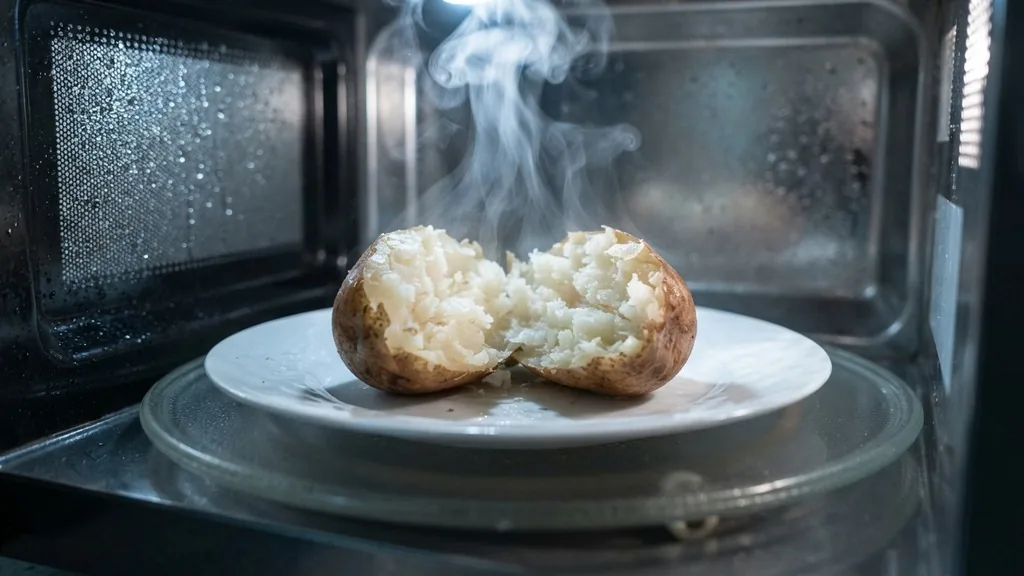
Achieving a perfectly fluffy, soft-centered baked potato using only your kitchen’s most convenient appliance is entirely possible if you master the timing. Learning how long to bake a potato in the microwave is a fundamental culinary skill that saves significant time compared to conventional oven roasting.
While a standard oven might require upwards of an hour to yield a tender tuber, a microwave can reduce this timeframe to just a handful of minutes. The secret lies in understanding how the microwave oven interacts with the starch and moisture content of the potato, as well as how to adjust your cooking strategy based on the size and quantity of your spuds.
Understanding the Mechanics of Microwave Potato Cooking
When you place a potato inside a microwave, you are utilizing electromagnetic waves to excite the water molecules within the vegetable. This vibration generates heat internally, which effectively steams the potato from the inside out.
Unlike a conventional oven, which relies on conductive heat to crisp the skin and slowly penetrate the dense starch, the microwave is a steam-generating machine. Because of this, the texture of a microwaved potato is naturally softer and lacks the dehydrated, crispy skin associated with traditional baking.
To achieve the best results, you must consider the size potato you are working with. A small, thin-skinned potato will reach the desired internal temperature much faster than a large, dense Russet. Furthermore, the number of potatoes you place in the appliance simultaneously will influence the time required.
As you add more potatoes, the energy from the microwave is distributed across a larger mass, necessitating a longer total duration. It is a common misconception that one fixed timeframe applies to every situation; in reality, the wattage of your specific microwave and the total mass of the food are the primary variables that dictate success.
Calculating Precise Timing Based on Potato Quantity
Determining exactly how long to bake a potato in the microwave requires a baseline approach. For a single, medium-sized potato, the standard timeframe is typically between 5 to 7 minutes on microwave high power. However, this is rarely a “set it and forget it” task.
Most culinary experts recommend starting with a conservative estimate—perhaps 5 minutes—and then using a fork to test the tenderness. If the center still feels firm, you should add additional minutes in 1-minute increments.
When you are cooking multiple potatoes, the math changes significantly. Each additional potato added to the turntable effectively increases the total cooking load. If you are preparing two potatoes, you should expect to add roughly 3 to 4 minutes to the initial 5-minute baseline.
If you are attempting to cook four potatoes at once, the time could easily extend to 15 or 20 minutes. It is vital to arrange the potatoes in a circular pattern around the edge of the microwave turntable rather than stacking them in the center. This ensures that the electromagnetic waves interact with each potato more evenly.
| Number of Potatoes | Estimated Cooking Time (Minutes) |
|---|---|
| One | 5–7 minutes |
| Two | 8–11 minutes |
| Three | 12–15 minutes |
| Four | 16–20 minutes |
The Essential Step of Preparing the Potato
Before you even consider the time settings, you must prepare the vegetable properly. Neglecting this step can lead to uneven cooking or, in rare cases, a burst potato due to pressure buildup. Start by thoroughly washing the skin to remove any soil.
Once clean, use a sharp fork to pierce the skin of the potato at least 6 to 8 times across the entire surface. These small holes act as vents, allowing the steam generated during the cooking process to escape safely. Without these vents, the internal pressure can cause the potato to split or explode, creating a significant mess inside your appliance.
Some home cooks choose to wrap the potato in a paper towel. This is an excellent technique for retaining moisture, which prevents the skin from becoming excessively tough or leathery. If you prefer a slightly more dehydrated skin, you can place the potato directly on the microwave-safe tray, though you might find the texture less appealing.
Regardless of the method, always ensure the potato is dry after washing; excess water on the surface can result in a “soggy” skin rather than a fluffy interior. For more information on food safety and handling, you can consult the official food safety guidelines provided by the federal government regarding proper preparation and storage.
Addressing Common Challenges and Topical Gaps
One of the most frequent questions regarding this process is whether one can combine the microwave and the conventional oven. This “hybrid” method is widely considered the “cheat” for the perfect baked potato. By microwaving the potato for 5 to 7 minutes first, you essentially par-cook the interior, ensuring it is soft and ready.
You then transfer the potato to a preheated 400-degree oven for another 10 to 15 minutes. This brief period in the oven crisps the skin, providing that classic, restaurant-style finish that a microwave alone cannot replicate.
Another common point of confusion is whether you should flip the potatoes during the cooking process. While not strictly mandatory, flipping or rotating the potatoes halfway through the time is highly recommended if you are cooking more than one.
Microwaves often have “cold spots” where the energy density is lower. By rotating the potatoes, you guarantee that every serving receives an equal amount of radiation, preventing the frustrating experience of having one perfectly cooked potato and one that is still raw in the middle.
Tips for Achieving Perfect Texture Every Time
Achieving a fluffy interior is the hallmark of a well-executed baked potato. To ensure your results are consistent, keep these best practices in mind:
- Always use a microwave-safe dish or plate to catch any moisture or starch that might leak during the process.
- Avoid using plastic wrap, as it can trap too much steam and result in a gummy texture.
- If you want to add flavor, rub a light coating of olive oil and salt on the skin after microwaving, then let it sit for a minute before serving.
- Check for doneness by inserting a knife into the thickest part of the potato; if it slides in with zero resistance, it is ready.
- Allow the potato to “rest” for at least 2 minutes after removing it from the microwave, as the internal temperature will continue to rise and the steam will redistribute throughout the flesh.
It is also worth noting that the age and variety of the potato play a role in the cooking outcome. Starchy varieties like Russets are naturally higher in dry matter, which makes them fluffier when cooked.
Waxy potatoes, such as Red Bliss or Yukon Golds, have a higher moisture content and will behave differently under microwave radiation. They tend to become creamy rather than fluffy, which might be preferable for certain dishes but requires a slightly different approach to timing.
Troubleshooting Common Microwave Issues
Sometimes, despite your best efforts, you might encounter issues like hard centers or shriveled skin. A hard center is a definitive sign that the potato was not cooked for enough high minutes or that the microwave power level was inconsistent. If you discover a hard spot after the timer goes off, do not simply restart the cycle for another 5 minutes.
Instead, add just 1 or 2 minutes at a time. Overcooking is a real risk; once a potato is over-microwaved, it becomes dehydrated and loses its structural integrity, turning into a dense, chewy mass that is difficult to salvage.
If the skin becomes too shriveled, you have likely lost too much moisture. This happens if you cook the potato for too long or without the protection of a paper towel. To revive a slightly over-microwaved potato, you can slice it open and add a generous amount of butter or sour cream immediately.
The fat will help rehydrate the starch and mask the texture issues. Remember, the microwave is an aggressive cooking tool; it is always better to undercook by a minute and test the potato than to overcook and compromise the quality of the meal.
Frequently Asked Questions
Can I microwave a potato without pricking it with a fork?
No, you should never skip this step. Pricking the skin creates essential vents for steam to escape. Without these holes, the internal pressure can build up rapidly, causing the potato to burst, creating a significant mess and potential safety hazard inside your microwave.
Is it better to use the high power setting for the entire time?
Yes, for a standard baking process, you should use the microwave’s maximum power setting. Microwaves are designed to work most efficiently at full power. Lowering the power level will simply extend the cooking time without providing any meaningful benefit to the texture or quality of the potato.
How do I know when the potato is fully cooked?
The most reliable test is the “fork test.” Insert a sharp fork or a paring knife into the thickest part of the potato. If the tool slides in and out with virtually no resistance, the potato is fully cooked. The skin should also feel slightly soft to the touch.
Does the size of the potato significantly change the timing?
Absolutely. A large, heavy potato can take several minutes longer than a small one. If you are cooking multiple potatoes of different sizes, try to group them by size and cook them in batches, or place the larger ones toward the edge of the turntable for more direct energy exposure.


