

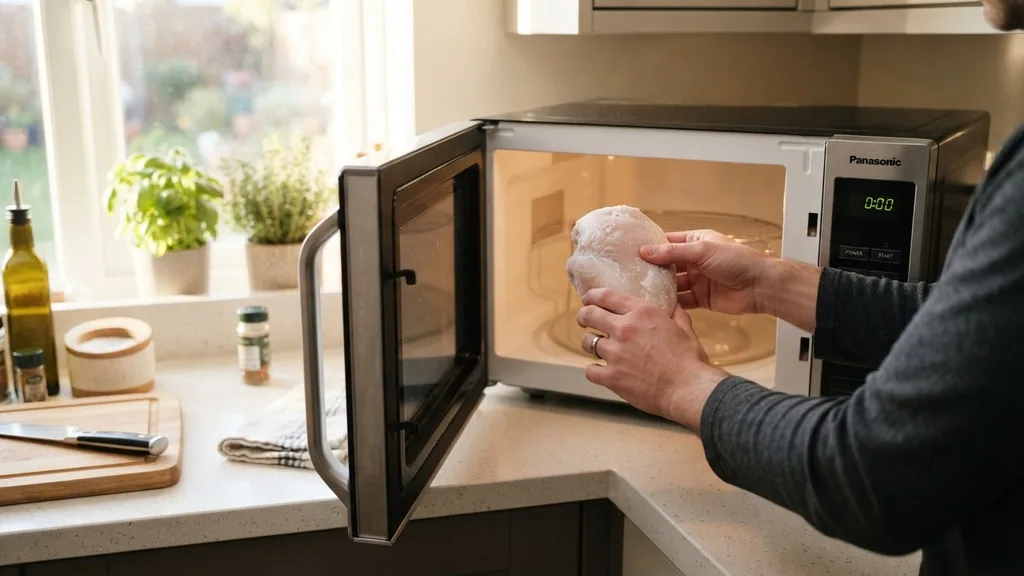
When you find yourself staring at a rock-hard block of frozen poultry with dinner only an hour away, knowing how long to defrost chicken in microwave settings becomes a vital kitchen skill. While the refrigerator remains the gold standard for food safety, the microwave offers a rapid, efficient alternative when time is of the essence.
However, this method requires precision, as the uneven nature of microwave radiation can lead to “hot spots” where the meat begins to cook before the center has fully thawed. Mastering the balance between speed and quality is essential for preventing bacterial growth and ensuring your meal remains succulent rather than rubbery.
Understanding the Mechanics of Microwave Defrosting
The primary reason many home cooks struggle with microwave defrosting is a misunderstanding of how the appliance actually functions. Unlike a conventional oven that relies on ambient heat to slowly raise the temperature of the air, a microwave uses electromagnetic waves to excite water molecules within the food. These molecules vibrate rapidly, creating friction that generates heat.
When you are working with frozen items, these waves target the ice crystals first. Because liquid water absorbs energy much more efficiently than ice, as soon as a small portion of the chicken turns into liquid, that specific spot begins to absorb energy at an accelerated rate.
This physical phenomenon is precisely why you often see thin edges of a chicken breast turning white or grey while the center remains icy. To mitigate this, most modern microwaves feature a dedicated defrost setting. This function typically cycles the power level down to 20% to 30%, allowing for “rest periods” where the thermal energy can conduct throughout the meat without the edges getting blasted by continuous high-intensity waves.
If your microwave does not have a specific button, manually adjusting the power level to 30% is the most effective way to mimic this gentle thawing process. Never attempt to defrost on full power, as this will result in uneven, rubbery, and potentially unsafe poultry.
Determining the Right Amount of Time by Weight
The most accurate way to calculate how long to defrost chicken in microwave cycles is to rely on weight rather than guesswork. Most experts recommend allowing approximately two to three minutes per pound of meat. However, this is a baseline, and your specific appliance’s wattage will significantly influence the outcome.
A high-wattage microwave (1200W+) will naturally thaw items faster than a compact, low-wattage model (700W). If you are uncertain about your microwave’s power, it is always safer to underestimate the time and check the progress frequently.
It is helpful to weigh your chicken before placing it in the appliance. If you have multiple pieces, try to arrange them in a single layer with the thickest parts facing the outer edge of the turntable.
This arrangement ensures that the parts of the chicken that require the most energy receive it, while the thinner, more delicate parts stay toward the center where the radiation intensity is slightly lower. Below is a general reference table to help you estimate the initial duration for common weights, but remember to adjust based on visual cues.
| Weight of Chicken | Estimated Time (Low Power) |
|---|---|
| 0.5 lb (approx. 225g) | 2 to 3 minutes |
| 1 lb (approx. 450g) | 5 to 7 minutes |
| 1.5 lbs (approx. 680g) | 8 to 10 minutes |
| 2 lbs (approx. 900g) | 12 to 14 minutes |
Essential Safety Protocols for Microwave Thawing
Food safety is the most critical consideration when dealing with raw poultry. According to guidelines provided by the United States Department of Agriculture, you must cook the chicken immediately after it has been defrosted in the microwave.
This is because the microwave process can bring portions of the meat into the “danger zone”—the temperature range between 40°F and 140°F where bacteria multiply at an exponential rate. If you leave the chicken sitting on the counter or put it back in the refrigerator after microwaving, you are inviting significant foodborne illness risks.
Furthermore, you must ensure that your microwave is clean before starting. Residue from previous meals can harbor bacteria that might contaminate the surface of the raw chicken. Use a microwave-safe dish to catch any juices that may leak during the thawing process.
These juices are a prime vector for cross-contamination. Once the cycle is complete, wash your hands, the microwave tray, and any utensils that touched the raw chicken thoroughly with hot, soapy water. If you notice the edges of the chicken have started to cook or turn opaque, do not be alarmed, but treat this as a signal that the chicken must go directly into the pan or oven.
Step-by-Step Execution for Even Thawing
To achieve the best results, you need a systematic approach to the defrosting process. Simply pressing a button and walking away is a recipe for disaster. Instead, follow these steps to maintain quality and safety:
- Remove the chicken from its original packaging. Many store-bought plastic wraps are not designed for microwave heat and can melt or leach chemicals.
- Place the chicken on a microwave-safe plate or shallow dish.
- Set your microwave to 30% power. If you only have one power setting, you will need to pulse the microwave (run for 30 seconds, wait for 30 seconds).
- Flip the chicken pieces over every 2 minutes. This is crucial for uniform thawing.
- Rotate the plate if your microwave does not have a turntable to ensure even distribution of energy.
- Check the center of the meat for remaining ice crystals. Use your fingers to press into the thickest part; if it still feels rigid or icy, continue in 30-second increments.
- Once the meat is pliable and no longer frozen, proceed immediately to your cooking method of choice.
By following these steps, you minimize the risk of overcooking the edges while waiting for the core to thaw. The goal is to reach a state where the meat is fully defrosted but still cold to the touch, rather than warm or partially cooked.
Common Mistakes to Avoid During the Process
One of the most frequent errors home cooks make is attempting to defrost a whole chicken in the microwave. Due to the density and irregular shape of a whole bird, the microwave is almost guaranteed to produce uneven results.
The wings and breast meat will likely cook through while the cavity remains frozen, creating a texture that is simultaneously dry and raw. If you are in a rush, it is always better to break the chicken down into parts or, if you have the time, use the cold water method as an alternative.
Another common pitfall is ignoring the state of the packaging. Even if the packaging is labeled “microwave-safe,” it is generally better to remove it. Trapped steam can cause the plastic to shrink or tear, potentially contaminating the chicken with melted plastic residue.
Additionally, failing to account for the “carryover” heat is a mistake. Even after the microwave stops, the internal temperature of the food continues to rise for a minute or two.
If you microwave the chicken until it feels perfectly “ready,” you have likely already overcooked the outer layers. Always stop slightly before you think it is fully thawed and let it sit for a moment.
Addressing Topical Gaps: Microwave vs. Other Methods
Many people ask if they should choose the microwave over the refrigerator or cold water. The refrigerator is the safest way to thaw chicken, as it keeps the meat at a consistent, safe temperature below 40°F.
However, this method requires planning, often taking 24 hours or more for larger cuts. If you forgot to take the chicken out of the freezer, the refrigerator is not an option.
The cold water method is another common alternative. To use this, you place the chicken in a leak-proof plastic bag and submerge it in a bowl of cold tap water, changing the water every 30 minutes. This is often better than the microwave for preserving the texture of the meat, as it thaws the chicken more gently.
However, it still requires 1 to 3 hours depending on the size of the cut. The microwave is the only option that offers results in under 15 minutes.
Understanding these trade-offs allows you to make an informed decision based on your specific time constraints and the type of dish you are preparing. If you are making a stew or a stir-fry, the slight texture changes from microwave defrosting are often negligible, whereas if you are planning to grill a pristine chicken breast, the cold water or refrigerator method is vastly superior.
FAQ: Common Queries About Defrosting Poultry
Is it safe to microwave chicken to defrost?
Yes, it is safe, provided you cook the chicken immediately after the process is finished. The key is to avoid letting the meat sit at room temperature, which encourages bacterial growth. Always use a low power setting to prevent the meat from reaching dangerous temperatures.
How do I know when the chicken is fully defrosted?
The chicken is ready when it is flexible and no longer feels icy or rigid in the center. Use your fingers to check the thickest part of the meat. If it is still firm, continue the process in 30-second intervals until it is completely pliable.
Can I defrost chicken in its original plastic packaging?
It is strongly recommended that you remove the chicken from its original packaging before microwaving. Many commercial plastic wraps are not heat-resistant and can melt or release harmful chemicals into your food. Use a microwave-safe glass or ceramic dish instead to catch any juices.
Why does my chicken turn white when I defrost it in the microwave?
If your chicken is turning white or grey, it is beginning to cook. This happens because the microwave energy is being absorbed unevenly. To prevent this, always use a lower power setting (30%) and flip or rotate the chicken frequently to ensure the heat is distributed more evenly.


