

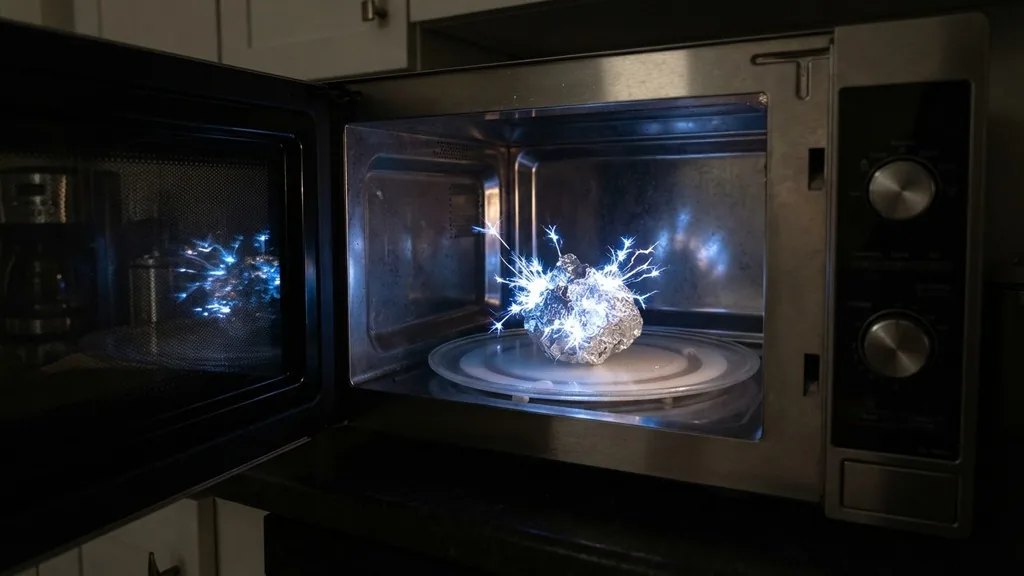
Many home cooks have spent decades operating under a strict kitchen commandment: never let metal touch the inside of your microwave. The fear of seeing bright, jagged sparks dancing behind the glass door is enough to deter anyone from experimenting with aluminum foil.
However, the question of whether aluminum foil can go in the microwave is more nuanced than a simple “yes” or “no.” While the general advice remains to avoid it to prevent damage, understanding the physics behind why this happens—and the rare scenarios where it might be permissible—is essential for any home cook looking to improve their kitchen safety and efficiency.
At its core, the microwave oven functions by emitting electromagnetic waves that cause water molecules in food to vibrate, generating heat through friction. When you introduce a conductive metal like aluminum foil into this environment, the interaction between the waves and the metal is immediate and potentially volatile. To truly understand the risks and the science, we must look at how these appliances interact with various materials and why the geometry of the metal plays such a critical role in the outcome.
The Physics of Arcing and Electrical Discharge
The primary concern when placing metal in a microwave is a phenomenon known as arcing. Arcing occurs when the electromagnetic waves produced by the microwave magnetron induce an electrical current in the metal object.
If the metal is thin or has sharp edges, the electrical potential becomes too high for the surrounding air to insulate, leading to a breakdown of the air’s dielectric properties. This results in a visible electrical discharge or sparks jumping between the foil and the microwave wall or between two pieces of foil.
The intensity of this effect is highly dependent on the shape of the metal. A smooth, flat sheet of foil is less likely to cause an issue than a crumpled ball with jagged, pointed edges. These sharp points concentrate the electric field, making it much easier for the air to undergo dielectric breakdown.
When this happens, the air ionizes and creates a path for the electricity to travel, which is the visual manifestation of sparks. This process is not only startling but can also cause serious damage to the microwave’s interior coating, the waveguide cover, or even the magnetron itself if the energy is reflected back into the source.
Beyond the immediate risk of sparks, there is the concern of the fire hazard. If the electrical discharge occurs near flammable materials like paper towels, plastic wrap, or dry food particles, it can easily ignite a fire.
This is why manufacturers of microwave ovens provide explicit warnings against using metal. They are not merely trying to prevent minor cosmetic damage to the appliance; they are attempting to mitigate the risk of house fires and expensive repair bills caused by internal arcing.
Understanding Microwave Shielding and Reflection
To understand why foil behaves the way it does, it helps to think of the microwave as a metal box designed to keep energy inside. The walls of your oven are essentially a giant cage that reflects electromagnetic waves back toward the center of the unit. When you place an aluminum tray or a sheet of foil inside, you are introducing another reflective surface that alters the distribution of that energy.
Because aluminum is a conductive metal, it does not absorb microwave energy; instead, it acts as a mirror. This is known as microwave shielding. If you cover a portion of your food with foil, the waves will bounce off the foil rather than penetrating the food underneath.
This can be useful in specific, controlled circumstances, such as preventing the edges of a casserole from drying out or overcooking while the center is still cold. However, the margin for error is razor-thin. If the foil is not placed correctly—or if it is too close to the side walls of the microwave—the reflection can interfere with the appliance’s heating efficiency, potentially leading to hot spots or damage to the magnetron due to the reflected energy overloading the system.
For those interested in the technical specifications of how these appliances are tested and regulated, you can review the FDA guidelines on microwave oven radiation to better understand the safety standards that manufacturers must follow to protect consumers.
Comparing Materials for Microwave Use
Not all materials interact with microwave energy in the same way. The following table illustrates how different common kitchen materials behave when subjected to the intense electromagnetic environment of a microwave.
| Material | Interaction with Microwaves | Safety Rating |
|---|---|---|
| Glass (Borosilicate) | Transparent; waves pass through | Safe |
| Ceramic | Generally transparent; may absorb heat | Safe (if no metallic paint) |
| Aluminum Foil | Highly reflective; induces current | Use with extreme caution |
| Plastic (Microwave-safe) | Transparent; does not absorb energy | Safe |
| Stainless Steel | Highly reflective; high risk of arcing | Avoid |
As shown in the table, the distinction between “safe” and “unsafe” often comes down to electrical conductivity and the potential for arcing. While glass and ceramic are inert, metals like aluminum and stainless steel force the microwave to work harder, which can lead to uneven heating or hazardous electrical events.
The Myth of the 30-Second Rule
A common misconception circulating on social media is that it is safe to use aluminum foil in the microwave as long as you keep the duration very short, such as 30 seconds or less. This is a dangerous oversimplification. Arcing is not a time-dependent phenomenon; it is an instantaneous reaction to the presence of an electric field. If the conditions for an electrical arc are present—such as a sharp, crumpled edge or the foil being positioned too close to the microwave’s wall—the spark can occur the very millisecond the power is engaged.
There is no “safe” duration for creating a dangerous electrical environment. While it is true that a small, smooth piece of foil might not spark immediately, the risk is never zero. Relying on a timer to prevent a fire is a recipe for disaster.
If you find yourself needing to cover food to prevent splattering or to manage heat distribution, it is far safer to utilize dedicated microwave-safe containers or microwave-safe covers made of glass or silicone. These materials are engineered to be transparent to electromagnetic waves, ensuring that your food heats evenly without the risk of electrical damage.
Safe Alternatives to Aluminum Foil
If your goal is to reheat food without drying it out or to keep your microwave clean, there are several superior alternatives to using foil. The industry standard for food safety and appliance longevity is to use materials that are specifically labeled as microwave-safe.
* Glass Lids: These are excellent for trapping steam and preventing splatters while allowing you to monitor the cooking process.
* Microwave-Safe Silicone Covers: These are flexible, heat-resistant, and can be placed directly over bowls or plates.
* Paper Towels: A simple, cost-effective way to cover food and absorb moisture, provided they are not placed in contact with high-fat foods for too long.
* Ceramic Plates: Using a ceramic plate to cover a bowl is a time-tested kitchen hack that is perfectly safe and effective.
* Parchment Paper: This is a safe, non-reactive alternative if you need to cover a baking dish.
By incorporating these items into your routine, you eliminate the need to gamble with aluminum foil. These alternatives offer superior heating efficiency because they do not reflect the waves away from the food, ensuring that your meal reaches the desired temperature more quickly and uniformly.
Topical Gaps: Addressing Specific Microwave Scenarios
A frequent query involves whether aluminum trays used for pre-packaged meals can be safely microwaved. Many manufacturers include instructions on their packaging that explicitly state whether the container is microwave-safe. Often, these trays are made of a specific type of thin aluminum that is designed to be used in the microwave, but even then, the instructions usually specify that the lid must be removed and the tray should be placed in the center of the glass turntable.
Another common question is whether you can use foil for “shielding” during the defrosting process. Some chefs suggest using small strips of foil to cover the extremities of a piece of meat (like the wings of a chicken or the thin ends of a roast) to prevent them from cooking faster than the thicker parts. While this is technically possible, it requires a high degree of precision.
The foil must be smooth, must not touch the walls of the microwave, and must not be placed near any other metal. If you choose to attempt this, the risk remains yours, and it is generally recommended to use a lower power setting to reduce the intensity of the electromagnetic waves and the subsequent risk of arcing.
Furthermore, consider the state of your microwave. Older units with worn-out paint or damaged interior walls are much more susceptible to the effects of electrical discharge.
Even if you think you are being careful, a small scratch in the interior finish can act as a focal point for an arc, turning a minor mistake with foil into a major appliance failure. Maintaining the interior of your microwave is just as important as being cautious about what you place inside it.
Best Practices for Microwave Maintenance
To ensure your appliance remains a reliable tool in your kitchen, prioritize regular cleaning and inspection. A buildup of food debris, especially grease and sugar, can carbonize over time. This charred material is conductive, and if it accumulates on the walls or the waveguide cover, it can create a localized area where arcing is much more likely to occur, regardless of whether you have used metal or not.
Always inspect the interior for signs of pitting or exposed metal. If you see areas where the enamel has chipped away, you should avoid using any metallic objects, even those labeled as “microwave-safe,” as the exposed metal of the microwave’s chassis can interact with the waves. By following these best practices, you extend the lifespan of your appliance and ensure that your cooking environment remains as safe as possible.
While the temptation to use foil for convenience is understandable, the potential risks to your equipment and your safety far outweigh the minor benefits. Stick to microwave-safe materials, keep your appliance clean, and always prioritize the integrity of your microwave’s interior.
Frequently Asked Questions
Can I use a small piece of foil to cover a part of my food?
While some sources suggest using small, smooth pieces of foil to shield specific areas of food from overcooking, it is generally discouraged. The risk of arcing is high if the foil is not perfectly smooth or if it is positioned too close to the microwave’s interior walls.
What should I do if I see sparks in my microwave?
Immediately turn off the microwave and unplug it from the power source. Do not open the door until the sparking has completely stopped. Once it is safe, remove the item that caused the spark and inspect the interior of the microwave for any signs of damage or burn marks.
Are all aluminum containers unsafe for microwave use?
Not necessarily, but you must follow the manufacturer’s instructions. Some pre-packaged meals come in specialized aluminum trays designed for microwave use. These are usually shallow and have specific guidelines for placement. If the packaging does not explicitly state it is microwave-safe, you should always transfer the food.
Does the age of my microwave affect safety when using metal?
Yes. Older microwaves or those with damaged interior coatings are significantly more prone to arcing. If your microwave has scratches, exposed metal, or a damaged waveguide cover, the presence of any conductive material, including aluminum foil, significantly increases the likelihood of a dangerous electrical discharge or permanent appliance damage.


