
Determining exactly how long to boil water in a microwave requires more nuance than simply pressing a button and walking away. While many assume that a microwave acts like a kettle, the physics of water heating in a microwave environment is distinct.
The time needed to reach a rolling boil depends heavily on your microwave’s wattage, the volume of liquid, and the type of container you are using. On average, a standard 1000-watt microwave will bring one cup of water to a boil in approximately two to three minutes, but this is merely a baseline that fluctuates based on several environmental variables.
Understanding the Physics of Microwave Heating
When you heat water in a microwave, you are utilizing dielectric heating. The appliance emits electromagnetic waves that cause polar molecules—primarily water—to rotate rapidly.
This friction generates the heat required to raise the temperature of the liquid. Unlike a stove, which transfers heat from the bottom of a pot upward through conduction, a microwave excites the water molecules throughout the entire volume of the liquid simultaneously.
Because the heating process is volumetric, the time it takes to reach a boil is directly tied to the total mass of the water. If you double the amount of water, you generally need to increase the heating time by significantly more than double, because the energy is being shared across a larger number of molecules. Furthermore, the efficiency of this process is dictated by the microwave’s power output.
A 700-watt unit will naturally take much longer than an 1100-watt unit to achieve the same result. The key to success is patience and monitoring, as microwave energy can create “superheated” water, a dangerous phenomenon where water exceeds its boiling point without actually bubbling, which can lead to sudden, violent eruptions if the liquid is disturbed.
Factors Influencing Heating Duration
Several external factors determine the exact duration required to heat your water. The most significant variable is the power wattage of your specific microwave model. You can often find this information printed on a label inside the door or on the back of the machine.
A higher wattage means more energy is delivered per second, resulting in shorter wait times. If your microwave is older or lower in power, you should adjust your expectations accordingly.
The material of the container also plays a critical role. You must always use microwave-safe glass or ceramic. Never use metal, as it can cause arcing and damage your appliance.
Furthermore, the shape of the vessel affects how the waves interact with the water. A wide, shallow bowl will expose more surface area to the air, which can lead to faster evaporation but potentially slower overall temperature gains compared to a deep, narrow mug. Additionally, the initial temperature of the tap water matters; if your water starts at room temperature, it will reach a rolling boil much faster than if it comes directly from a cold pipe.
Recommended Timing by Volume
To provide a practical baseline, we can estimate times based on a standard 1000-watt microwave. It is essential to note that these figures are approximations. Always keep a close eye on the process, especially during your first few attempts.
| Volume of Water | Estimated Time (1000W) |
|---|---|
| 1 Cup (8 oz) | 2 to 2.5 minutes |
| 2 Cups (16 oz) | 3.5 to 4 minutes |
| 4 Cups (32 oz) | 6 to 7 minutes |
| Small Mug (6 oz) | 1.5 to 2 minutes |
When you are preparing tea or instant coffee, you don’t necessarily need a violent, sustained boil. Often, simply getting the water to a steaming, near-boiling state is sufficient.
However, if you are sanitizing water or preparing freeze-dried meals, you must ensure the water stays at a true boiling water temperature for the required duration. Always remember that the liquid will continue to gain heat for a few seconds after the microwave stops, so use caution when removing the container from the oven.
Safety Protocols for Microwave Heating
Safety is paramount when working with high-temperature liquids. The most significant risk when heating water in a microwave is the potential for superheating.
This occurs when water is heated in a very smooth, clean container, preventing the formation of bubbles that would normally indicate the water is boiling. If you then drop a tea bag or a spoon into that water, the sudden introduction of a nucleation point can cause the water to explode upward.
To mitigate this risk, you should always place a wooden stir stick or a non-metallic object in the water during the heating process. This provides a surface for bubbles to form, ensuring that the water boils predictably. Furthermore, you should never leave the microwave unattended.
If you see the water start to bubble vigorously, stop the cycle immediately. Always use oven mitts or a thick towel to remove the container, as the mug or bowl can become dangerously hot, even if it is microwave-safe. For more detailed information on kitchen safety, consult the Food Safety and Inspection Service guidelines provided by the government.
Common Mistakes to Avoid
Many users fall into the trap of assuming that “more time is better.” Overheating water in a microwave can lead to the liquid boiling over, creating a mess that is difficult to clean.
If you are heating a large volume, it is often better to heat it in shorter, timed intervals. For example, if you estimate four minutes, heat it for three, stop to check the temperature, and then add thirty-second increments as needed.
Another common error is using the wrong type of container. Plastic containers, even those labeled as “microwave-safe,” can leach chemicals into the water when heated to the point of boiling. It is always best to stick to tempered glass or high-quality ceramic.
Also, avoid covering the container tightly. If you need to cover the water to prevent evaporation, use a loose-fitting microwave-safe saucer, but ensure there is plenty of room for steam to escape. A pressure build-up inside a closed container can lead to a dangerous burst when you finally open the door.
How to Identify a Rolling Boil
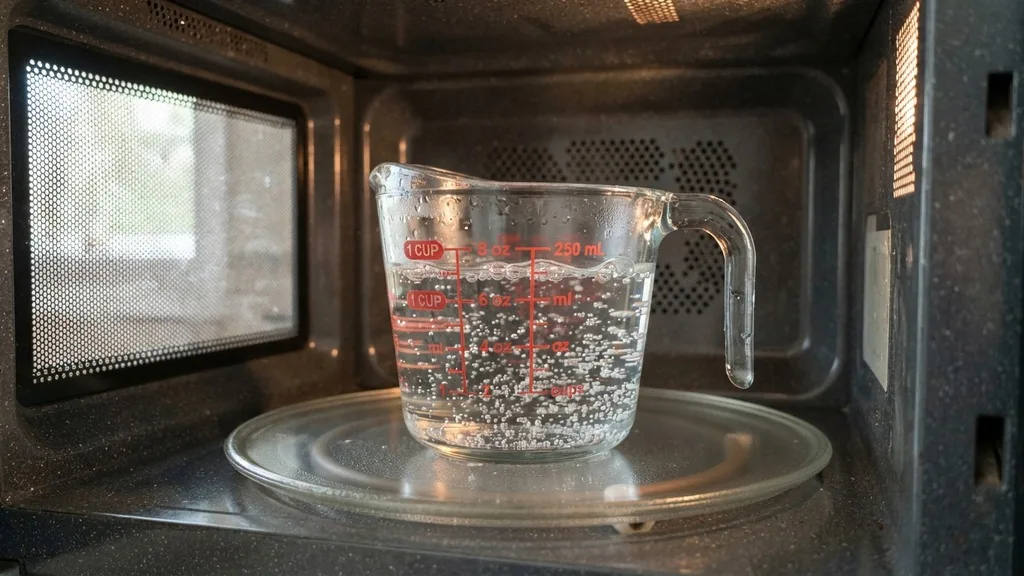
Recognizing when your water has reached a rolling boil is essential for tasks like brewing delicate green tea or properly rehydrating food. A rolling boil is characterized by large, active bubbles that continue to form even when the water is being stirred. If you only see small bubbles forming at the bottom of the container, the water is simmering but has not yet reached the boiling point.
- Use a thermometer if you need an exact temperature, such as 212°F (100°C).
- Look for constant, vigorous surface movement, not just steam.
- Listen for the sound of bubbling; it will be distinct and consistent.
- Ensure the water is not just “hot” but actively agitated by steam release.
- Be aware that after heating, the water will settle quickly once the radiation stops.
If your goal is to sanitize water, the CDC generally recommends a rolling boil for at least one minute. In a microwave, this is difficult to achieve consistently. It is often safer to heat the water until it is very hot and then hold it at that temperature, though a stovetop method is vastly preferred for water purification purposes.
Addressing Topical Gaps and Common Queries
A frequently overlooked aspect of this process is the “re-heating” effect. If you have already boiled water once and let it sit, it will reach a boil much faster the second time because the container itself is already pre-heated. This thermal mass effect is why your second cup of tea is often ready faster than the first.
Additionally, many people ask if it is “safe” to boil water in a microwave. The answer is yes, provided you follow the basic safety protocols regarding superheating and container choice.
Another gap in common knowledge is the effect of water quality. Hard water, which contains higher levels of minerals, may behave slightly differently than distilled or filtered water. Minerals can act as natural nucleation points, potentially reducing the risk of superheating, but they can also leave residue on your container.
If you notice your microwave-heated water has a strange metallic or “off” taste, it is likely that your container is retaining flavors from previous uses or that the water quality in your area is interacting with the heating vessel. Always clean your microwave-safe mugs thoroughly to avoid this issue.
Frequently Asked Questions
Is it safe to boil water in a microwave?
Yes, it is safe as long as you use a microwave-safe container and avoid superheating. To prevent water from suddenly erupting, always place a non-metallic object, like a wooden chopstick or stirrer, in the container to provide a surface for bubbles to form as the water reaches its boiling point.
Why does my water not bubble until I touch it?
This is called superheating. It happens when water is heated in a very smooth container without a place for bubbles to form. The water reaches a temperature above its boiling point without bubbling. Once you disturb the water, it can suddenly and violently boil over, which can cause severe burns.
How do I know if my container is microwave-safe?
Look for the “microwave-safe” symbol on the bottom of the dish, which usually looks like a square with wavy lines. If there is no symbol, avoid it. Never use any container with metallic trim or foil, as these materials can spark, damage your microwave, and potentially start a fire inside the appliance.
Does wattage change how long I should boil water?
Absolutely. A 700-watt microwave will take significantly longer to boil water than a 1200-watt model. You should always adjust your timing based on your specific appliance’s power. If you are unsure of your microwave’s wattage, start with shorter intervals and check the water temperature frequently until you find the right timing.


